Best Web Design for Ecommerce: 7 Picks That Convert
Why does a store that wins design awards still lose the sale at checkout? Because looking good and selling well are different crafts, and only one of them shows up in a portfolio. The best web design for ecommerce survives contact with real shoppers: someone on a train, someone with three tabs open, someone who has forgotten their password twice. Online sales made up 27.7% of all retail sales in Great Britain in September 2024, so the website isn't a brand brochure, it's a shop floor.
I judge every studio below on three things. Journey clarity means a customer can find, compare and buy without guessing. Brand consistency means the site, the email and the campaign landing page feel like the same company. Conversion-focused detail means delivery costs, form fields, mobile taps and error states were designed rather than left to default. The seven entries cover different needs, from freelance design leadership and premium Shopify Plus builds to fixed-price sprints and platform-flexible agencies. Each ends with a takeaway you can apply to your own store this week.
Table of Contents
1. Steeve Elgui
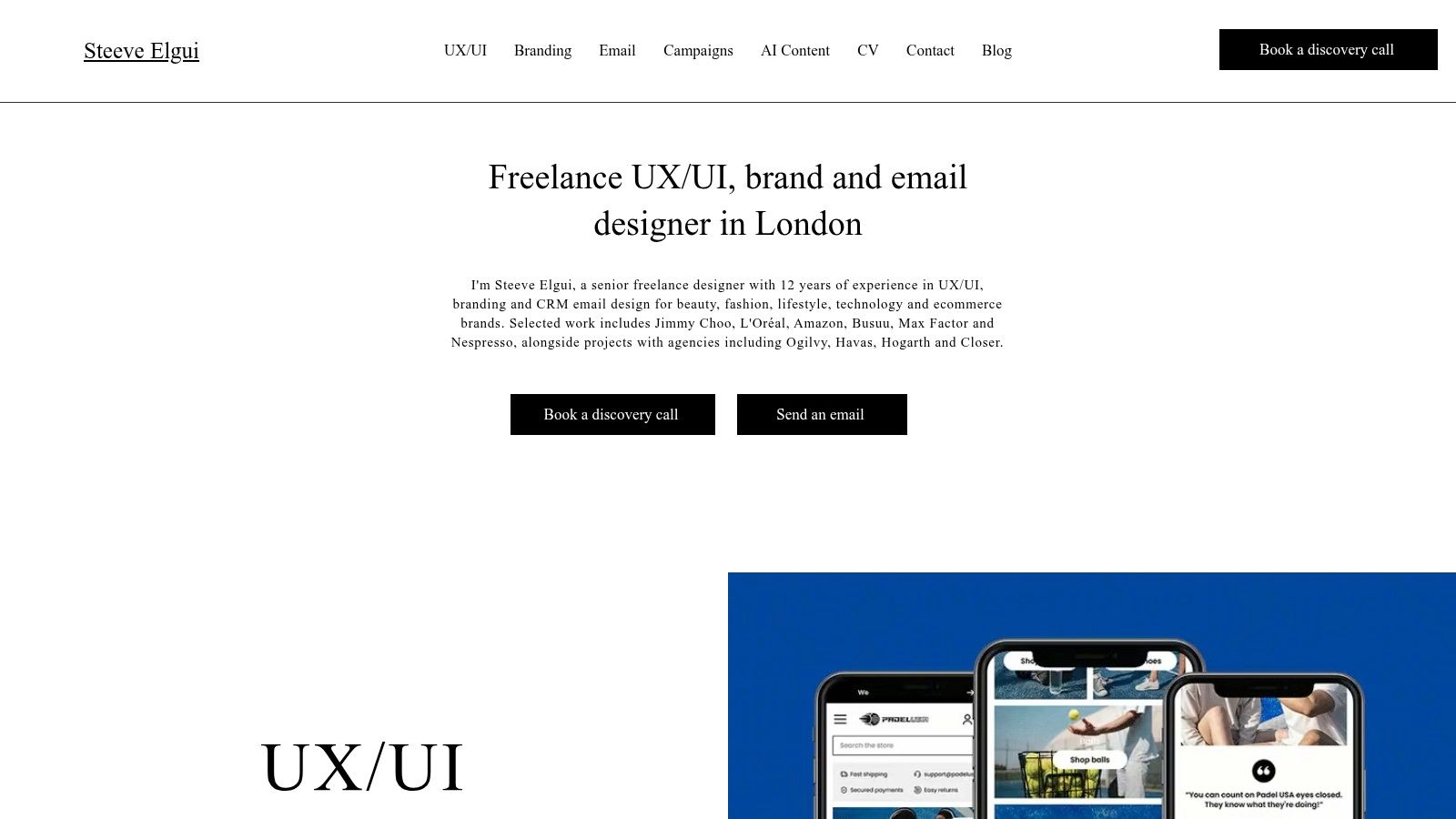
Steeve Elgui is a London-based senior freelance designer with 12 years across UX/UI, branding, CRM email design and digital campaigns. That range shows up in the small things most studios hand off: the same product shot cropped two ways, two button styles, a checkout that looks nothing like the welcome email. For beauty and lifestyle brands, design breaks at exactly those seams.
Journey mapping, design systems and the email that follows
UX/UI work covers wireframes, journey mapping, design systems and brand integration. Branding covers logo, typography, colour palettes, guidelines, art direction, packaging and print. Email covers responsive builds, campaign planning and A/B testing, while campaign support spans concepting, art direction and multi-format delivery. Putting all of it in one brief is the practical advantage: a homepage hero and the email template promoting the same collection get resolved together instead of in parallel. The portfolio names Jimmy Choo, L'Oréal, Amazon, Busuu, Max Factor and Nespresso, alongside agency time at Ogilvy, Havas, Hogarth and Closer.
Journey work also decides whether a store is usable at all. UK reporting on the barriers disabled shoppers face online found that 81% of disabled consumers struggled to complete online transactions, 38% abandoned purchases at checkout because of accessibility barriers, and only 13% completed a typical retail journey independently. Just 9% contacted customer support and 4% formally reported an issue, so your analytics will never show you the true size of the problem. Map the path from filters through payment verification to returns, and test it with people who don't work in your studio.
Pros
Cross-touchpoint consistency: one designer holding site, identity, email and campaign assets reduces the drift that appears when four suppliers work in isolation.
Twelve years across sectors: useful when a brand sells visually similar products and needs a system that differentiates them.
Direct or embedded: works with brands and inside agency teams on defined briefs.
Developer-ready deliverables: wireframe systems, journey maps, design systems and responsive email builds rather than static mockups.
Recommendations: former collaborators cite organisation, communication, strong brand interpretation and dependable deadlines.
Cons
Quote-based pricing: cost depends on scope, deliverables, involvement and review rounds, so you'll need a brief before you get a number.
Availability: project timing and ongoing support depend on the schedule already committed.
Ask for the boring screen. A freelancer's checkout error state tells you more about their ecommerce judgement than a styled homepage ever will.
Best fit: a brand that needs design leadership across website, identity and email, or an agency that needs a senior pair of hands for a launch.
2. DBCO

DBCO builds on Shopify Plus for premium fashion, luxury, beauty and lifestyle labels, and keeps creative direction and conversion work in the same room rather than treating them as separate phases. Listed projects include Stella McCartney, Balmain, Rat & Boa and Lyma, with typical redesigns running 8 to 16 weeks depending on scope.
Delivery and returns are a design decision
For high-ticket fashion, the shipping module converts harder than any hero image. DHL's 2025 UK ecommerce report states that three in four UK shoppers abandon their baskets when their preferred delivery and returns options are unavailable. If the returns policy lives in a footer accordion, you've built a funnel with a hole in it. Expose delivery price, estimated arrival, collection options, return window and return cost at product or cart level, then carry the chosen option through checkout without wiping payment details.
What the agency covers well
Premium sector focus: fashion, beauty and lifestyle merchandising habits, including lookbooks and editorial layouts.
Design and build together: Shopify Plus theme work, UX and development under one roof.
Ongoing retainers: email creative and conversion optimisation support after launch.
Where it won't fit
Budget starter stores: the premium positioning is priced accordingly, and nothing is published.
Platform flexibility: Shopify Plus is the house platform, so an Adobe Commerce catalogue is the wrong conversation.
Takeaway: if you sell at premium price points, budget for the returns experience as a designed feature rather than a policy page.
3. The Barn
Founder-led brands arrive with the same problem: the product story is clear in the founder's head and muddled on the homepage. The Barn works on Shopify and Shopify Plus with a consultancy layer attached, so priorities get settled before anyone opens a design file. Its portfolio includes Taller Marmo, Emily Nixon and &Sons, and the offer extends to migrations and post-launch growth support.
Designing for a trading calendar, not a launch day
Demand moves month to month, and the store has to move with it. The ONS recorded that online sales accounted for 27.8% of Great Britain retail sales in July 2024, after online spending rose 2.5% that month and 3.6% year on year. Small shifts, enormous volumes. The practical answer is reusable sections and merchandising controls a two-person team can operate: campaign blocks that swap cleanly, category pages that reorder without a developer, and product templates that hold their hierarchy under pressure.
A design system is the set of pages your team can change on a Tuesday without breaking the brand.
If that operating model is missing from the proposal, scope it as dedicated UX and UI work, not as another template request.
Strengths
Usability for lean teams: reusable sections and controls that survive fortnightly trading changes.
Brand consistency under load: less pretty redesign, more positioning that holds up on a category page.
Consultancy included: helpful when a founder needs a third party to arbitrate priorities.
Migration experience: relevant if you're moving platforms mid-year.
Limits
Shopify only: no route if you're committed to another stack.
No published pricing: cost depends on scope, deliverables and involvement, so budget conversations start from your project outline.
Provider-published proof: testimonials are the agency's own, so ask to speak to a client two years post-launch.
Takeaway: before commissioning a build, list the three pages your team will edit every fortnight. Those pages define the design system, and they tell you whether the agency is designing for conversion or for the launch screenshot.
4. FDRY
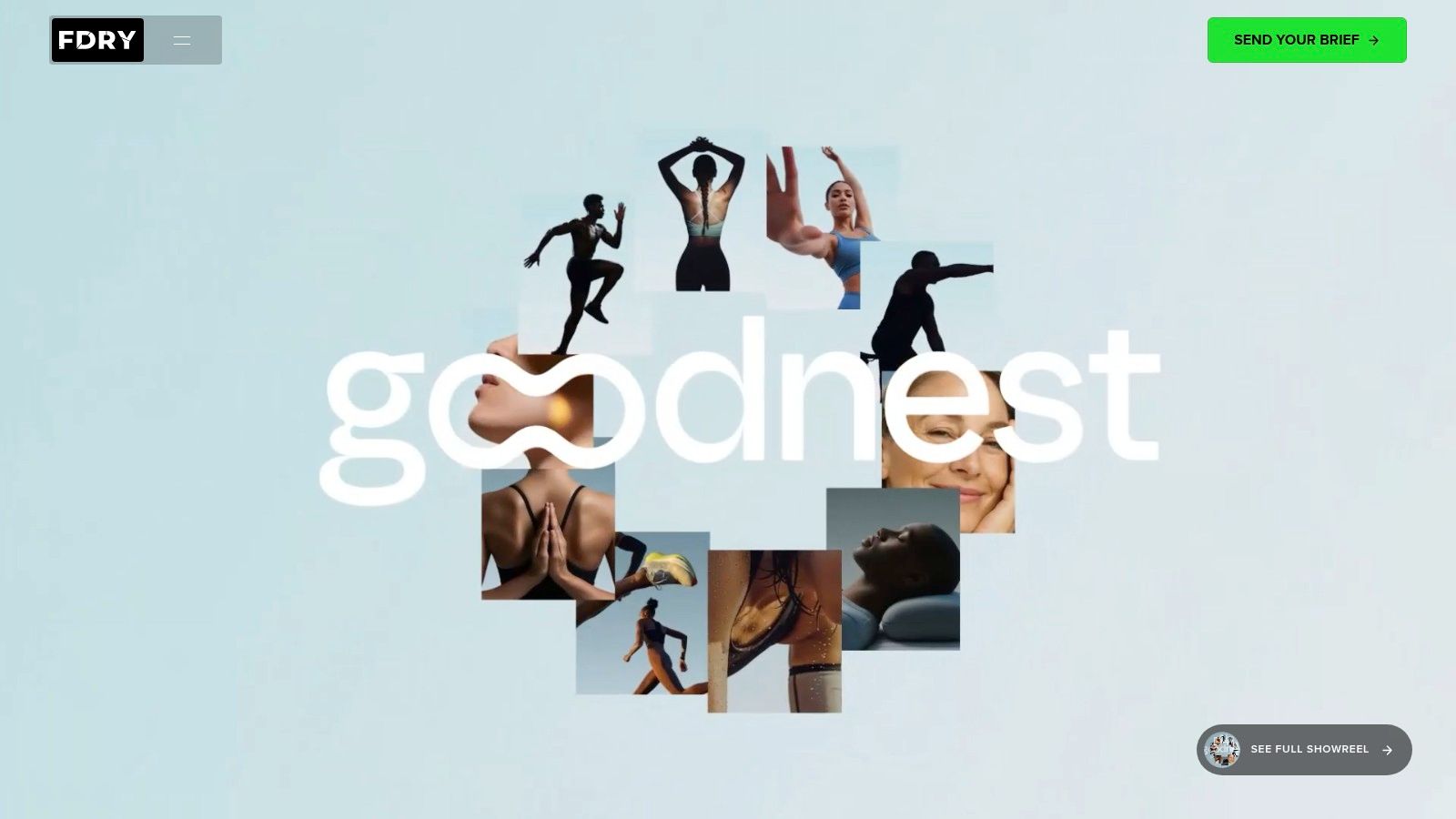
Platform commitment is the first decision that's hard to reverse, and FDRY is one of the few London agencies here working across Shopify, Shopify Plus, WooCommerce and Adobe Commerce. UX/UI, replatforming, ecommerce SEO, email and conversion rate optimisation sit alongside design and development, which suits a retailer coordinating a rebuild with post-launch growth work.
Time the migration against the numbers
Recovering from a rushed replatform usually costs a quarter. October 2025 retail figures show online sales values 4.8% higher than October 2024, with online at 28.1% of total retail sales, so a launch that slips into peak season is expensive. Sequence it properly: freeze feature work four weeks out, run old and new stores in parallel for a short window, give one named person the redirect map, and settle the brand elements that must survive the change before the theme does.
Strengths
Genuine platform choice: WooCommerce and Adobe Commerce as well as Shopify, which matters for complex catalogues.
Growth services attached: SEO, email and paid marketing pick up where the build stops.
Published case studies: you can read the brief, not just the screenshot.
Limits
Scope breadth: more than a design-only project needs, and the cost reflects that.
No published pricing.
Self-reported results: retention and performance figures come from the agency.
Takeaway: ask any multi-platform agency which platform they'd refuse to recommend for your catalogue, and listen to the reasoning.
5. Neat Digital
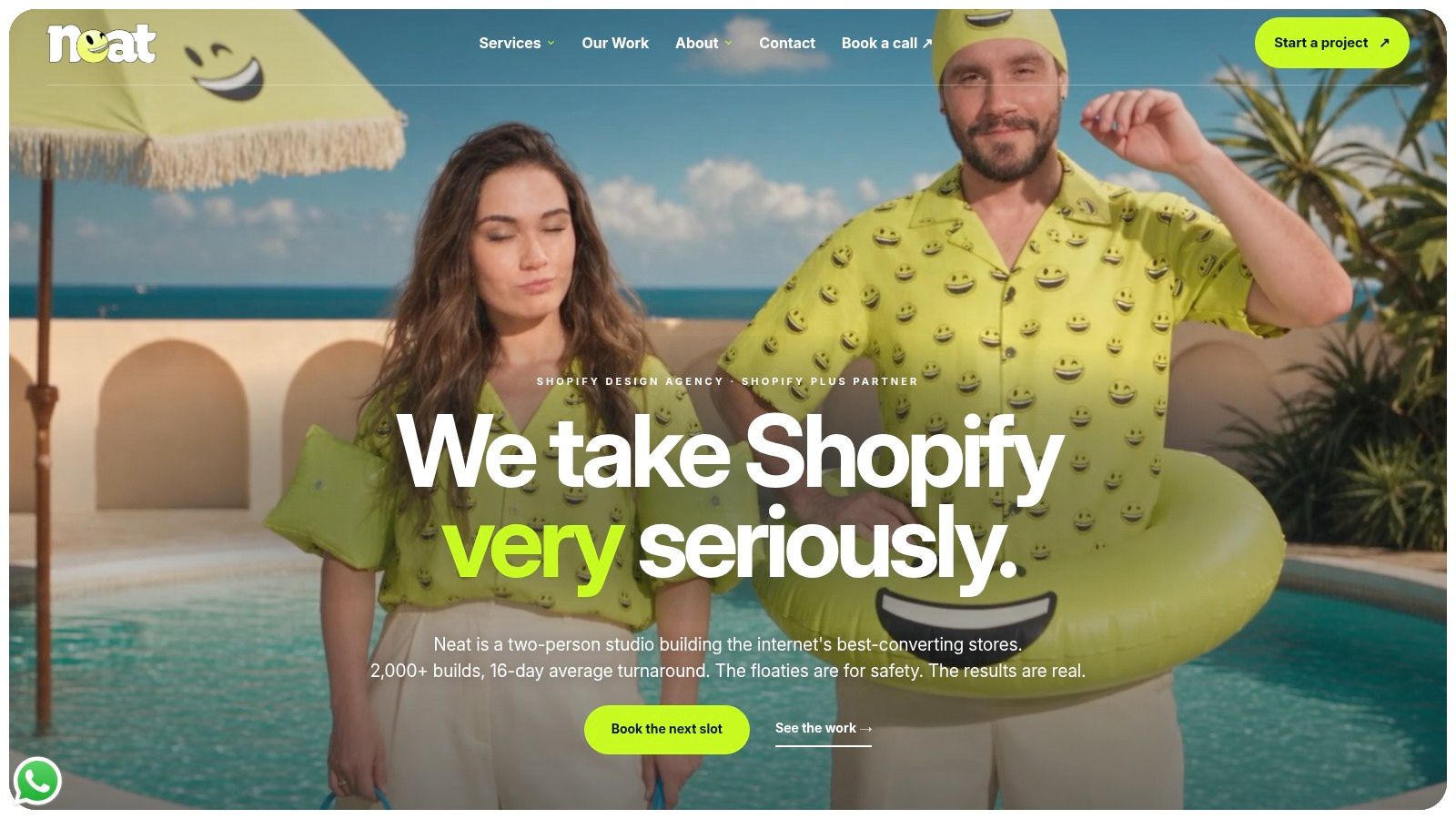
Neat Digital is a two-person Shopify studio and Shopify Plus Partner with the rare habit of publishing starting prices and sprint timelines on its own site. Fixed-scope design sprints cover store design, development, redesigns, migrations, and conversion and speed work, while monthly retainers carry the ongoing support. Talking directly to the founders removes a layer of account management.
The checkout is where the money leaks
Leeds Beckett University's checkout abandonment study reports that 74% of UK baskets created in the final quarter of 2024 did not become completed orders, with abandonment at 76% on mobile against 67% on computers. That gap is a design problem before it's a marketing problem: too many fields, hidden validation errors, a payment button that jumps when the keyboard opens. A fixed-scope sprint aimed at the phone checkout, with every field justified and autofill wired up, is where I would put a small conversion budget before touching anything else.
The usability lens favours this model. A sprint has to pick one problem and solve it, so the scope stays honest. Brand consistency is the weaker side: a two-person studio can keep a store coherent, but a rebrand across packaging, campaigns and social assets exceeds what a fortnight covers.
Strengths
Published starting prices and timelines: you can judge fit before you enquire.
Direct access to the founders: short feedback loops inside a sprint.
Focused scope: well suited to a redesign or a speed and conversion pass.
Limits
Capacity: two people, so parallel workstreams and enterprise discovery are limited.
Shopify only.
Short sprints: not a substitute for a full replatform, and promotional builds still need a landing page system, which campaign design support covers between sprints.
Takeaway: if abandonment is worse on mobile, spend the budget on the phone checkout, not another homepage refresh.
6. Smart Cookie Design
Few Shopify agencies put a number on the page before the first call. Smart Cookie Design does, and it splits the offer in two: theme customisation for a faster launch, and bespoke builds for brands that need more than a theme can carry. The agency publishes starting prices separately for each route, so you can compare the two paths on cost before getting in touch. Backend setup, a dedicated project manager and post-launch priority support come with the package.
Judged on the three lenses this roundup uses, the two-tier model is the interesting part. Usability and conversion work sit in either route, but brand consistency depends on which tier you buy: a customised theme limits how far the storefront can move away from familiar Shopify patterns, while bespoke gives the brand room to lead. Know which constraint you're accepting before the kickoff.
Mobile states, not mobile scaling
Responsive builds that squeeze the desktop layout leave the phone experience feeling like an afterthought. The 2025 Global Digital Shopping Index UK edition reports that 66% of UK consumers used a mobile device for their latest online purchase, roughly twice the share using a traditional computer, and that 58% used stored credentials during that transaction. Turn that into a spec: thumb-friendly controls, short vertical forms, autofill-compatible fields, guest checkout kept visible, and defined mobile states for variant selection and payment errors.
Strengths
Prices on the page: rare in this market, and it shortens the first conversation.
Two routes: theme customisation when speed matters, bespoke when the brand needs custom components.
Support after launch.
Limits
Shopify only.
Tier fit matters more than tier price: the theme route has to be viable for your catalogue and brand, or the cheaper option buys a refresh rather than a solution.
Starting prices: treat them as a floor, not a quote.
Takeaway: write the mobile states for variant selection, validation errors and payment handoff before you approve any design.
7. Venice
Venice works across Shopify, Magento, WordPress and Wix, and says it recommends a platform from each client's goals rather than its own specialism. Multilingual and multi-currency builds, ongoing support and ecommerce SEO sit in the same offer, alongside planning tools for assessing platform fit. Useful if you're still deciding, less useful if you've already committed.
Use the shortlist to ask harder questions
An agency that works across platforms is only as good as the team assigned to your project. Ask who does the work, then ask for a live URL on your chosen platform rather than a hero shot. Accessibility is a fair filter, because most stores fail it. A study of 115 UK ecommerce sites found that 97.4%, or 112 sites, had at least one critical or serious accessibility issue, averaging 38.4 issues per site: 90.4% had structural landmark-region problems, 73.9% failed on colour contrast and 72.2% had missing or unclear link text. Those faults are cheap to design out and expensive to retrofit.
Strengths
Platform-neutral advice: handy when nobody internally agrees on Shopify versus Magento.
Multi-market experience: multilingual and multi-currency storefronts.
Support after launch.
Limits
Team continuity: confirm which specialists would be assigned to your build.
No published pricing.
Agency-reported experience: check case studies that match your sector and platform.
Takeaway: add one line to every brief. Show us a page you launched that passes an automated accessibility scan.
Ecommerce web design options compared
Use three filters here: usability, brand consistency, and conversion fit.
Item | Design focus | Platform | Pricing transparency | Best for |
|---|---|---|---|---|
Steeve Elgui | UX/UI, branding, email, and campaigns | Shopify, HubSpot, and Wix website experiences | Quote after scope, timing, and budget outline | Brands needing one freelance designer across store, identity, and email touchpoints |
DBCO | Premium ecommerce design, UX, and creative direction | Shopify Plus | Quote-based; not published | Premium fashion, beauty, and lifestyle brands |
The Barn | Ecommerce design, strategy, and growth support | Shopify | Not publicly listed | Founder-led fashion and lifestyle brands |
FDRY | Ecommerce design, development, and growth services | Shopify, Shopify Plus, WooCommerce, Adobe Commerce | Not published on overview page | Established retailers planning a rebuild or migration |
Neat Digital | Shopify design, development, and focused sprints | Shopify, Shopify Plus | Published starting prices and retainer rates | Brands seeking focused projects and direct founder collaboration |
Smart Cookie Design | Shopify theme customisation and bespoke builds | Shopify | Published starting prices | Businesses choosing between a theme-based or bespoke Shopify store |
Venice | Ecommerce design, development, and platform guidance | Shopify, Magento, WordPress, Wix | Not published | Businesses seeking platform advice or multi-platform ecommerce support |
Narrow platform coverage usually signals deeper checkout, theme, and app knowledge. Broader coverage gives more routes when the build has several moving parts.
Three Questions to Ask Before Choosing Your Ecommerce Design Partner
Which platform are you committed to? If the answer is fixed, a Shopify-only studio narrows the field quickly and multi-platform agencies stop being relevant unless you're planning to move. If the answer is open, start from catalogue complexity and operational needs, not from whichever admin looked best in a demo.
Do you need design leadership or a full build? A full build covers strategy, design, development, QA and launch. Design leadership covers journey mapping, design systems and brand integration that your in-house or development team executes. Freelance support fits the second model, agencies fit the first, and plenty of brands need both at different stages.
How much do published prices and timelines matter? A published starting price tells you whether a conversation is worth having. An unpublished one doesn't mean expensive, it means scope comes first. Ask for the review rounds, the handover format and who owns the design files afterwards.
The last thing to weigh is what happens after launch. IMRG's State of Retail Email Marketing report found that 62.9% of surveyed consumers said email was their preferred channel for retailer updates, 48% engaged more with personalised emails and 76% were more likely to repurchase after a well-timed loyalty email. A partner who designs the store and then disappears leaves that channel unmanaged.
The highest-converting ecommerce design comes from teams that treat website, email and brand as one connected experience, with one design language and one set of rules.
A short brief covering the business, the goals, the support you need, the budget and your preferred timing is usually enough to start any conversation. Scope, deliverables and involvement decide the price, so the brief does most of the work before you've seen a single proposal.
If you want that joined-up view without hiring three separate suppliers, Steeve Elgui provides UX/UI design, branding and CRM email design from one London practice, covering journey mapping, design systems, wireframes and responsive email campaigns for beauty, fashion and lifestyle brands. A short brief with your goals, budget and preferred timing is enough to get a clear answer on scope, schedule and fit. Visit Steeve Elgui to see the ecommerce, branding and email work.
Comments